
Digital marketing has become one of the most powerful career paths in the modern digital economy. Businesses around the world depend on online platforms to promote their products, connect with customers, and grow their brands. Because of this shift, professionals who understand digital marketing skills are in high demand.
However, many beginners believe digital marketing is only about running ads or posting on social media. In reality, the field is much broader and involves a combination of technical, analytical, creative, and business abilities.
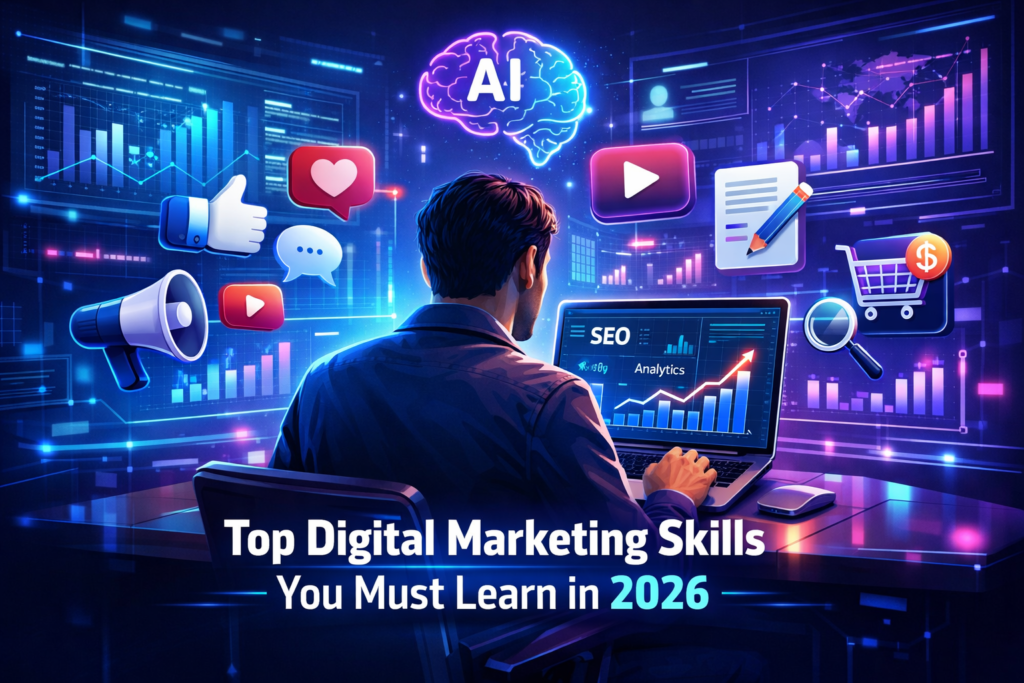
The image above represents six important areas that contribute to success in modern marketing: coding knowledge, communication ability, business understanding, professional skills, learning mindset, and data analysis. These areas together shape the foundation of strong digital marketing skills.
In this detailed guide, we will explore the most important abilities every marketer should develop to stay competitive in the digital age.

Why Digital Marketing Skills Matter Today
The internet has transformed how companies interact with customers. Traditional advertising such as television, newspapers, and billboards is no longer enough to compete in the online world.
Today’s businesses need professionals who understand how to use search engines, websites, content, and analytics tools effectively. This is why digital marketing skills are considered one of the most valuable professional capabilities.
According to industry reports, companies increasingly look for marketers who can combine creativity with technology. Someone who understands customer behavior, digital platforms, and performance data can help businesses grow faster.
Without proper knowledge, many marketing campaigns fail to deliver results. But professionals who build strong digital marketing skills can create effective strategies that attract the right audience.
Coding Knowledge in Digital Marketing
The first section of the image highlights coding and technical understanding. While digital marketers are not required to become professional developers, having basic technical knowledge can provide a major advantage.
Coding helps marketers understand how websites function and how different elements influence performance.
Some useful technical concepts include:
- HTML basics
- CSS fundamentals
- Website structure
- Page speed optimization
- Technical SEO
When marketers understand these concepts, they can collaborate more effectively with developers and improve website performance.
For example, a marketer who understands basic HTML can easily optimize page headings, meta tags, and image descriptions for SEO.
These technical abilities contribute significantly to advanced digital marketing skills.
Communication Skills for Marketers
Communication plays a crucial role in marketing success. Every marketing campaign depends on the ability to convey messages clearly and persuasively.
In the image, the communication section shows artificial intelligence, messaging, and email symbols. These represent the different channels marketers use to communicate with audiences.
Communication includes:
- Writing engaging content
- Email marketing campaigns
- Social media messaging
- Advertising copywriting
- Brand storytelling
Strong communication helps businesses connect emotionally with customers.
For example, when a company launches a product, the marketing message must clearly explain its benefits. If the message is confusing or poorly written, customers may ignore the offer.
Marketers with excellent writing and storytelling abilities develop stronger digital marketing skills that improve brand trust and engagement.
Understanding Business Strategy
The business section of the image highlights another essential element of marketing success.
Marketing is not just about promotion; it is deeply connected with business goals such as revenue growth, customer acquisition, and brand reputation.
Professionals must understand how marketing activities support overall business strategy.
Important business concepts include:
- Market research
- Customer segmentation
- Pricing strategy
- Brand positioning
- Sales funnels
When marketers understand these concepts, they can design campaigns that produce measurable results.
For example, a digital marketer working with an online store must understand the sales funnel—from attracting visitors to converting them into paying customers.
Business knowledge strengthens digital marketing skills because it allows marketers to align campaigns with company objectives.
Professional Skill Development
Another important part of the image focuses on professional skills.
These include personal abilities that help marketers perform efficiently in fast-changing digital environments.
Examples of professional capabilities include:
- Time management
- Problem solving
- Creativity
- Strategic thinking
- Collaboration
Digital marketing projects often involve working with designers, developers, content writers, and advertising specialists.
Strong teamwork and project management abilities allow professionals to coordinate campaigns smoothly.
Continuous improvement is also important. Technology and consumer behavior change quickly, which means marketers must constantly upgrade their digital marketing skills.
The Importance of Continuous Learning
The second “skills” section in the image represents learning and personal growth.
Successful marketers treat learning as an ongoing process rather than a one-time activity.
Digital platforms evolve rapidly. New tools, algorithms, and trends appear every year.
For example:
- Search engines frequently update ranking algorithms
- Social media platforms introduce new advertising formats
- Artificial intelligence tools transform marketing automation
Professionals who stay updated with industry trends maintain strong digital marketing skills and remain competitive in the job market.
Learning can happen through many channels:
- Online courses
- Industry blogs
- Marketing communities
- Practical experiments
Marketers who invest in continuous education often achieve better long-term results.
How Creativity Improves Marketing Performance
Creativity is another powerful factor in marketing success.
Businesses compete for attention in crowded digital environments. Creative campaigns help brands stand out and attract audience interest.
Creative thinking can influence many areas of marketing:
- Social media content ideas
- Advertising visuals
- Video marketing
- Brand storytelling
- Interactive campaigns
Creative marketers develop unique strategies that make brands memorable.
When creativity is combined with analytical thinking, professionals build well-balanced digital marketing skills that produce both engagement and measurable results.
Real-World Example of Skill Integration
Imagine a digital marketing professional working for an e-commerce brand.
Their daily tasks may include:
- Writing product descriptions
- Managing advertising campaigns
- Analyzing website traffic
- Optimizing landing pages
- Communicating with design teams
To perform these tasks effectively, they need a mix of technical knowledge, creativity, and business understanding.
All these abilities together form a strong foundation of digital marketing skills that allow the marketer to contribute meaningfully to business growth.
The Growing Demand for Digital Marketers
As companies shift toward online platforms, the demand for digital marketing professionals continues to rise.
Organizations seek individuals who can:
- Increase website traffic
- Improve search engine rankings
- Generate leads
- Build brand awareness
- Analyze marketing performance
Professionals who invest time in developing digital marketing skills often find opportunities in multiple career paths.
These include:
- SEO specialist
- Social media manager
- content strategist
- digital advertising expert
- marketing analyst
The versatility of digital marketing makes it one of the most dynamic professional fields today.
Building Your Skill Foundation
For beginners, the best way to start developing marketing abilities is to focus on a few core areas first.
A strong foundation includes:
- Content creation
- Search engine optimization
- Social media marketing
- Basic analytics
- Communication and copywriting
Once these fundamentals are mastered, professionals can expand into advanced areas such as automation, data science, and conversion optimization.
Step-by-step learning allows individuals to gradually build powerful digital marketing skills that support long-term career growth.
we discussed the foundation of modern marketing, including coding knowledge, communication ability, business understanding, and continuous learning. These abilities form the base of strong digital marketing skills that professionals need to succeed in today’s competitive environment.
However, the digital world continues to evolve rapidly. Technologies like artificial intelligence, advanced analytics, and automation tools are changing how marketing campaigns are planned and executed.
In this second part, we will explore the advanced areas that help marketers strengthen their digital marketing skills and achieve better results for businesses.
The Role of Data Analysis in Digital Marketing
One of the most important abilities for modern marketers is the ability to understand and analyze data. The final section of the image highlights data analysis, which represents the analytical side of marketing.
Digital marketing generates a large amount of data. Every click, search query, website visit, and purchase can provide valuable insights into customer behavior.
Marketers who develop strong digital marketing skills learn how to interpret this data and use it to improve campaign performance.
Some important metrics marketers analyze include:
- Website traffic
- Bounce rate
- Conversion rate
- Click-through rate
- Customer acquisition cost
- Return on advertising spend
These metrics help businesses understand what is working and what needs improvement.
For example, if a marketing campaign generates high traffic but low conversions, the marketer must analyze the data to identify the problem.
By improving landing pages or adjusting the audience targeting, marketers can optimize campaigns using their digital marketing skills.
Understanding Marketing Analytics Tools
Data analysis becomes possible through powerful analytics tools. These tools allow marketers to track performance and measure the success of campaigns.
Some commonly used platforms include:
- Google Analytics
- Google Search Console
- SEMrush
- Ahrefs
- HubSpot analytics
- Social media insights tools
Learning how to use these tools effectively is an essential part of developing strong digital marketing skills.
For instance, Google Analytics allows marketers to track where website visitors come from, which pages they view, and how long they stay on the site.
This information helps marketers understand customer behavior and improve marketing strategies.
Professionals who understand analytics gain a major advantage because they can make decisions based on real data rather than assumptions.
Artificial Intelligence in Digital Marketing
Artificial intelligence is transforming many industries, including marketing.
AI tools help marketers automate tasks, analyze large datasets, and create personalized experiences for customers.
Modern digital marketing skills increasingly involve understanding how to use AI-powered tools effectively.
Some ways AI is used in marketing include:
- Chatbots for customer support
- AI content generation
- Predictive analytics
- Automated advertising optimization
- Customer segmentation
For example, AI tools can analyze user behavior patterns and recommend the best time to send marketing emails.
This improves engagement and increases conversion rates.
Marketers who learn to integrate AI tools into their strategies significantly strengthen their digital marketing skills.
Marketing Automation and Efficiency
Marketing automation is another important aspect of modern marketing strategy.
Automation tools allow businesses to manage repetitive tasks more efficiently. This saves time and ensures consistent communication with customers.
Examples of marketing automation include:
- Automated email sequences
- Customer relationship management systems
- Lead nurturing workflows
- Scheduled social media posts
- Automated reporting systems
Learning automation platforms such as HubSpot, Mailchimp, or ActiveCampaign is valuable for professionals who want to enhance their digital marketing skills.
Automation does not replace marketers. Instead, it allows them to focus on strategy and creativity while routine processes run automatically.
SEO Expertise for Long-Term Growth
Search engine optimization remains one of the most important areas of digital marketing.
SEO helps websites appear in search engine results when users search for relevant information.
Marketers with strong digital marketing skills understand how search engines work and how to optimize content for better visibility.
SEO involves several components, including:
- Keyword research
- On-page optimization
- Technical SEO
- Content strategy
- Link building
For example, keyword research helps marketers understand what people are searching for online.
By creating content around those topics, businesses can attract targeted visitors who are already interested in their products or services.
SEO may take time to produce results, but it generates sustainable traffic and builds long-term brand authority.
Content Marketing and Audience Engagement
Content remains one of the most powerful tools in marketing.
Businesses use blogs, videos, podcasts, and social media posts to educate and engage their audience.
Content marketing plays a central role in developing effective digital marketing skills because it helps build trust and authority.
High-quality content can:
- Attract organic traffic
- Improve SEO performance
- Educate potential customers
- Build brand credibility
- Generate leads
Marketers who understand storytelling and audience psychology can create content that resonates with readers.
For example, educational blog posts often attract visitors searching for solutions to specific problems.
By providing valuable information, businesses can establish themselves as trusted industry experts.
Social Media Marketing Skills
Social media platforms have become powerful marketing channels.
Millions of people use platforms such as Facebook, Instagram, LinkedIn, and YouTube every day.
Marketers with strong digital marketing skills understand how to use these platforms to build communities and promote brands.
Effective social media marketing involves:
- Content planning
- Audience engagement
- Paid advertising
- Influencer collaborations
- Performance tracking
Successful social media strategies focus on building relationships rather than simply promoting products.
Brands that provide entertaining, educational, or inspiring content often gain loyal followers.
Conversion Optimization
Attracting traffic is only one part of digital marketing. The ultimate goal is converting visitors into customers.
Conversion rate optimization focuses on improving the effectiveness of websites and marketing campaigns.
Professionals with advanced digital marketing skills analyze user behavior and test different elements to improve conversions.
Some optimization strategies include:
- Improving website design
- Simplifying checkout processes
- Writing persuasive call-to-action messages
- A/B testing landing pages
- Enhancing page loading speed
Small improvements in conversion rates can significantly increase revenue for businesses.
The Importance of Adaptability
Digital marketing evolves quickly. Algorithms change, new technologies appear, and consumer behavior shifts constantly.
Professionals who adapt quickly maintain strong digital marketing skills and remain competitive.
Adaptability involves:
- Monitoring industry trends
- Testing new tools
- Learning new platforms
- Updating marketing strategies
Marketers who remain flexible and open to change often achieve long-term success.
Future Trends in Digital Marketing
Looking ahead, several trends will shape the future of marketing.
These trends will influence the type of digital marketing skills professionals need to develop.
Some important trends include:
Artificial intelligence integration
Voice search optimization
Short-form video marketing
Personalized customer experiences
Privacy-focused data strategies
Marketers who stay informed about these trends can prepare themselves for the next generation of digital marketing.
Building a Successful Digital Marketing Career
Developing strong marketing abilities requires time and consistent practice.
Beginners should focus on learning step by step rather than trying to master everything at once.
A simple learning roadmap includes:
Step 1: Learn marketing fundamentals
Step 2: Practice SEO and content creation
Step 3: Understand analytics tools
Step 4: Experiment with social media marketing
Step 5: Learn automation and advanced strategies
By gradually building expertise, individuals can develop powerful digital marketing skills that support career growth.
Final Conclusion
Digital marketing is one of the most exciting and rapidly evolving industries today.
Professionals who combine creativity, technology, and analytical thinking can achieve remarkable success.
The image we explored highlights the major areas required for success: coding knowledge, communication ability, business understanding, professional skills, continuous learning, and data analysis.
Together, these areas form the foundation of strong digital marketing skills that enable marketers to design effective strategies and drive business growth.
Whether you are a student, entrepreneur, or professional, investing time in developing these abilities can open the door to countless opportunities in the digital world.
1. Google Digital Garage
https://learndigital.withgoogle.com/digitalgarage
Why link:
Google’s official platform for learning digital marketing fundamentals.
Suggested anchor text:
Learn digital marketing fundamentals from Google Digital Garage.
2. HubSpot Marketing Resources
https://blog.hubspot.com/marketing
Why link:
HubSpot provides expert insights on marketing strategies and tools.
Suggested anchor text:
Explore expert marketing strategies on the HubSpot Marketing Blog.
3. Moz Beginner’s Guide to SEO
https://moz.com/beginners-guide-to-seo
Why link:
One of the most trusted SEO learning resources.
Suggested anchor text:
Understand SEO basics with the Moz Beginner’s Guide to SEO.
4. Google Analytics Official Site
Why link:
Essential tool for analyzing website traffic and marketing performance.
Suggested anchor text:
Track marketing performance using Google Analytics.
More Articles –
Skills You Need to Start Digital Marketing in 2026
Official Update: BSEB 12th Result 2026 Today – How to Check Bihar Board Intermediate Result
10 Digital Marketing Terms Every Beginner Should Know (Complete Guide)
Digital Marketing Roadmap for Beginners: Complete Guide to Start in 2026
SEO vs Social Media Marketing: Which is Better for Beginners?
What is PPC in Digital Marketing? Complete Guide for Beginners
10 Digital Marketing Terms Every Beginner Should Know (Complete Guide)
How to Start Digital Marketing with Zero Investment (Complete Beginner Guide 2026)
Free Tools for Digital Marketing Beginners (Complete Guide 2026)
Digital Marketing Course Checklist: Complete Beginner Guide to Start Your Career
Digital Marketing Mistakes – Common Beginner Mistakes and How to Avoid Them